
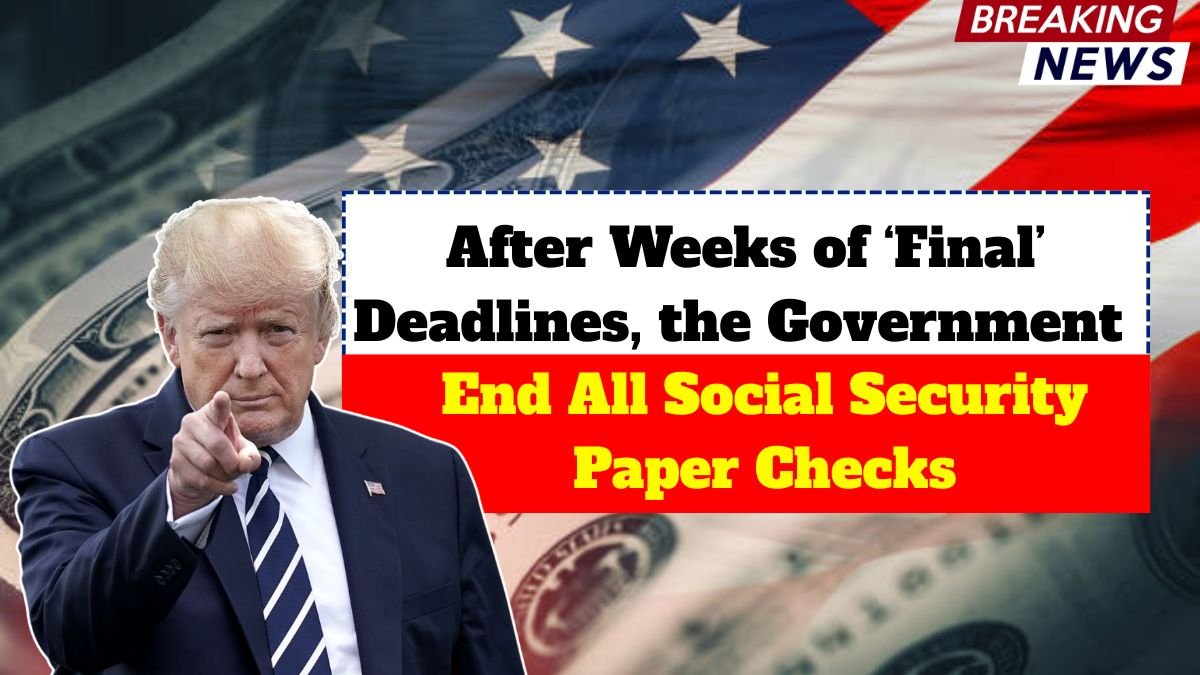
For weeks, millions of Americans were told—directly or indirectly—that the era of Social Security paper checks was coming to a definitive end. Official language emphasized “final” deadlines, firm transitions, and an unavoidable shift to electronic payments. For seniors, people with disabilities, and beneficiaries living in rural or underserved areas, the message was clear: adapt quickly or risk disruption. But now, without much fanfare, the government appears to be stepping back from that hardline position, softening its stance and signaling that paper checks may not disappear as abruptly—or as completely—as once promised.
This quiet reversal has raised important questions. Why were the deadlines framed so definitively in the first place? What changed behind the scenes? And most importantly, what does this mean for the people who still depend on paper checks to pay rent, buy groceries, and maintain a sense of financial stability?
The Original Push to End Paper Checks
The push to eliminate Social Security paper checks did not emerge overnight. For years, policymakers have argued that electronic payments—whether through direct deposit or prepaid debit cards—are more efficient, less costly, and more secure. Printing and mailing checks involves administrative expenses, postal delays, and the constant risk of theft or fraud. From a purely operational standpoint, moving everything online seems like a logical modernization step.
Government agencies also pointed to broader digital trends. Banking, tax filing, and benefit administration have increasingly moved online, and Social Security was seen as lagging behind. Officials framed the transition as inevitable, describing paper checks as outdated and inefficient in a world where instant electronic transfers are the norm.
In theory, the plan made sense. In practice, it overlooked the realities of millions of beneficiaries who do not fit neatly into a digital-first framework.
Why the Deadlines Felt So Alarming
What made this particular rollout so unsettling was the language used. Communications referenced “final” deadlines, creating the impression that there would be no flexibility or exceptions. For older Americans who have relied on paper checks for decades, these warnings felt abrupt and intimidating.
Many beneficiaries live without reliable internet access, especially in rural areas. Others lack bank accounts due to past financial hardships, mistrust of financial institutions, or high fees that make maintaining an account impractical. Some seniors simply feel uncomfortable navigating online systems, fearing mistakes that could jeopardize their only steady source of income.
For these individuals, paper checks are not a preference—they are a lifeline. The idea that this lifeline could be cut off by an inflexible deadline created widespread anxiety.
Public Reaction and Growing Pressure
As the deadlines drew closer, advocacy groups, senior organizations, and disability rights advocates began sounding the alarm. They warned that forcing a rapid transition could lead to missed payments, confusion, and financial distress among the most vulnerable populations.
Stories began to circulate of seniors who had never used online banking, people without smartphones, and beneficiaries living in areas where mail service, while slow, was still more reliable than internet connectivity. Lawmakers received calls from constituents worried about losing access to their benefits through no fault of their own.
Behind the scenes, pressure mounted. The policy, while efficient on paper, was becoming a public relations and political liability. Ending paper checks too quickly risked alienating a large and vocal segment of the population—many of whom depend almost entirely on Social Security to survive.
The Quiet Shift in Tone
Rather than announcing a dramatic reversal, the government opted for a quieter approach. Recent statements have softened the language around deadlines, emphasizing flexibility, accommodations, and extended timelines. References to “final” cutoffs have largely disappeared, replaced by reassurances that beneficiaries will not be left without support.
This shift suggests a recognition that the original messaging underestimated the complexity of the issue. While electronic payments remain the long-term goal, officials now appear more willing to acknowledge that a one-size-fits-all solution does not work for Social Security recipients.
The absence of a major press announcement is telling. Instead of admitting a misstep outright, the policy seems to be evolving quietly, allowing agencies to save face while responding to public concern.
Why Paper Checks Still Matter
In an increasingly digital world, it can be easy to dismiss paper checks as relics of the past. But for many Social Security recipients, they represent stability, familiarity, and control.
Paper checks do not require passwords, internet access, or technical troubleshooting. They arrive in a tangible form, something recipients can see, hold, and track. For individuals who have been managing their finances the same way for decades, this consistency is deeply reassuring.
There is also a trust factor. Some beneficiaries distrust electronic systems, fearing hacking, data breaches, or unauthorized withdrawals. While electronic payments are generally secure, perception matters—especially when people are dealing with their only source of income.
The Digital Divide Is Still Real
The attempt to phase out paper checks has highlighted a broader issue: the persistent digital divide in the United States. Access to technology is not evenly distributed, and comfort with digital tools varies widely across age groups and communities.
Older adults are statistically less likely to use online banking. Low-income individuals may lack access to reliable devices or internet service. People with certain disabilities face accessibility challenges that make digital systems difficult to navigate.
Until these gaps are meaningfully addressed, eliminating non-digital options risks excluding exactly the people Social Security is meant to protect.
Administrative Efficiency vs. Human Impact
From a government perspective, efficiency matters. Electronic payments reduce costs, streamline operations, and minimize certain types of fraud. These are legitimate concerns, especially in a system as large and complex as Social Security.
But public programs are not just about efficiency—they are about people. When policies prioritize administrative convenience over human impact, unintended consequences are almost inevitable. The backlash against ending paper checks underscores the importance of balancing modernization with compassion and flexibility.
The quiet walk-back suggests that officials are beginning to recalibrate that balance.
What This Means for Beneficiaries Now
For current Social Security recipients who still receive paper checks, the recent shift should offer some relief. While electronic payments remain encouraged, the immediate threat of losing access appears to be diminishing.
That said, uncertainty remains. Without a clear, definitive statement, beneficiaries may still feel uneasy about the future. Many are left wondering how long paper checks will truly remain an option and whether another push to eliminate them could emerge down the line.
For now, the message seems to be that transitions will happen more gradually, with greater consideration for individual circumstances.
The Long-Term Direction Is Still Digital
Despite the softening tone, it would be unrealistic to assume that paper checks will remain indefinitely. The long-term direction of government payments is undeniably digital. Electronic systems offer advantages that are difficult to ignore, especially as younger, more tech-savvy generations age into the Social Security system.
The key lesson from this episode is not that modernization should stop, but that it should proceed thoughtfully. Providing education, support, and real alternatives is essential if transitions are to succeed without causing harm.
A Lesson in Policy Communication
One of the most striking aspects of this situation is how much of the backlash stemmed from communication rather than policy alone. The use of absolute language like “final” deadlines created fear and resistance that might have been avoided with a more measured approach.
Clear, compassionate communication is especially important when dealing with programs that millions rely on for survival. People need time, information, and reassurance—not ultimatums.
The government’s quiet retreat may reflect an understanding that how a policy is presented can be just as important as the policy itself.
Conclusion: A Pause, Not a Reversal
The government’s decision to quietly walk back its plan to end all Social Security paper checks is less a full reversal and more a strategic pause. It acknowledges the realities faced by beneficiaries while keeping the door open for gradual modernization.
For now, paper checks remain a vital option for many Americans. Their continued existence is a reminder that progress should not come at the expense of accessibility or dignity. As the conversation around Social Security payments continues, the challenge will be finding a path forward that embraces technology without leaving anyone behind.
In the end, this episode serves as a powerful reminder that public policy is not just about systems and savings—it is about people, their habits, their fears, and their need for stability in an uncertain world.
FAQs
Q1. What is the government’s plan regarding Social Security paper checks?
A. The government had planned to end all paper checks and move beneficiaries to electronic payments.
Q2. Why is the plan being delayed or walked back?
A. After repeated “final” deadlines, officials are reconsidering due to public feedback and logistical challenges.
Q3. How does this affect Social Security recipients?
A. Recipients who prefer paper checks may continue receiving them for now until the plan is fully implemented.
